
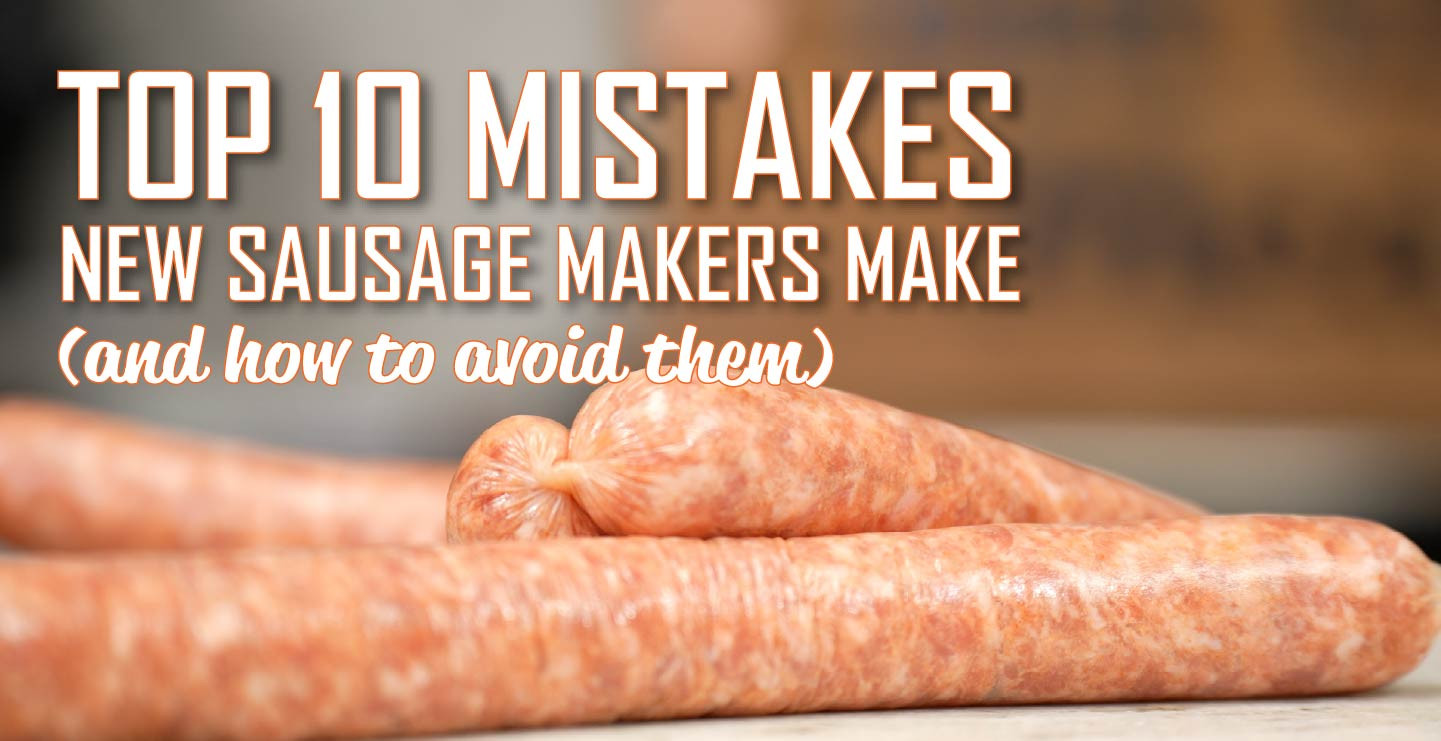
Top 10 Mistakes New Sausage Makers Make
For beginners, Sausage Making can be a very intimidating process. You have to break down a whole muscle cut, then mix in the seasoning and additives correctly, stuff it into a sausage casing and then cook it, all without making any fatal mistakes. Here is a list of the top 10 mistakes most beginners make when attempting to make any type of sausage. If you can avoid these mistakes you will quickly learn that making a basic fresh sausage is easy, and a cured sausage, like a snack stick, is only slightly more difficult.
For beginners, Sausage Making can be a very intimidating process. You have to break down a whole muscle cut, then mix in the seasoning and additives correctly, stuff it into a sausage casing and then cook it, all without making any fatal mistakes. Here is a list of the top 10 mistakes most beginners make when attempting to make any type of sausage. If you can avoid these mistakes you will quickly learn that making a basic fresh sausage is easy, and a cured sausage, like a snack stick, is only slightly more difficult.
Fat % is too low
Whether we are making a Snack Stick, Summer Sausage, or a Bratwurst we want to have between 20-25% fat in our sausage. When making sausage from wild game we often see that people do a 50/50 mix of wild game and pork butt. The issue with that is that pork butts are at best 25% pork fat, so if you are using half pork butt and half wild game you will be lucky to have 12.5% fat in your sausage. If you are making sausage from wild game or a low-fat cut of meat, you should go to your local butcher shop and get straight pork fat. The fat should be under $2 a lb and will help you make some of the best sausages of your life!
Meat not cold enough
One of our biggest "enemies" during the sausage making process is heat. It can cause a myriad of problems, from smearing to spoilage. The good news is that it is actually a simple thing to prevent, with just a few steps you can reduce the chances of heat related issues to almost zero.
Partially freezing your meat before you begin grinding will not only speed up your grinding process, but also keep the meat safer.
Putting your entire grinder head assembly, including plates and knives in the freezer 30 minutes before you begin grinding will prevent the heat that is generated from the grinder's body (or the friction of the plate and knife) from heating up your meat.
Make sure extra meat that does not fit into your stuffers cannister is placed back in a cooler while you are stuffing. This is especially important if you are making a large batch of sausage with a smaller sausage. Yes, it will take you a few more minutes to take the meat out of the cooler before loading your stuffer, but cold meat stuffs better and smears less than warm meat.
Smearing your meat while grinding
When your meat starts looking pink instead of having clearly defined portions of bright white fat, and darker pinkish-red pieces of meat. Smeared meat has a strong tendency to have texture issues, such as a grainy or sandy consistency, and can also lead to flavor deficiencies as the fat melts out of the product quicker. The 2 main causes of this are:
Dull plates and knives while grinding - The meat gets overworked during the grinding process if your knives and plates cannot effectively cut the meat. Instead of a nice clean cut you end up with mushy pink meat. Depending on the style of plates and knives you have you can either have them sharpened, or you will have to replace them.
Meat warmed up too much during the process - If you do not keep your meat cold enough it will smear when grinding and mixing. To prevent this make sure you are starting with cold meat and that you transfer meat back into the cooler if it is going to sit out for more than a few minutes before being processed.
Use the right additives
If you are making a fresh sausage like a Bratwurst or a Breakfast Sausage then you might not use anything beyond just the seasoning. But, if you are making a cured sausage like a Snack stick or Summer Sausage then you must choose between 4 different options for a binder, 3 different options for a cure accelerator and you will most likely want to add a high-temp cheese as well. Knowing when to use what additive is essential to making a good sausage. Check out more information on additives in our Meatgistics University section on Additives
Lack of proper sanitation
Some of the bacteria and micro-organisms that we are worried about during sausage making can duplicate every 20 minutes. This in fact means that a single cell can multiply to over 1,000,000 in about 7 hours, don't believe us? Well, 1 - 2 - 4 - 8 - 16 - 32 - 64 - 128 - 256 - 512 - 1,024 - 2,048 - 4,096 - 8,192 - 16,384 - 32,768 - 65,536, - 131,072 - 262,144 - 524,288 - 1,048,576. So, every one of those doublings is 20 minutes and there are 20 of them. So 3, 20 minute periods in an hour, so just about 7 hours!
Make sure you are using something like Maxim Hard Surface Sanitizer before your meat touches any surface and that your equipment and supplies are kept clean and sanitized between uses!
Incorrect mixing
If you search Meatgistics.com for the term protein extraction you will get 92 pages of results, that is how important of a concept this is. Protein extraction is when we mix our meat enough so that the proteins begin to bind to each other, they will act almost like Velcro, grabbing onto each other and surrounding pieces of fat. This is important because no matter how slowly we cook it the fat will melt before the protein will fully cook. If the proteins are tightly bound to each other there will be nowhere for the fat to go, and it will solidly when cooled.
However, knowing what it is isn't the only hurdle, you also have to know when and how to use it. When making a fresh sausage we want to stop mixing well short of achieving protein extraction or we will have an odd texture that doesn't fit a breakfast sausage or bratwurst. So, it should only be used when we are making a cured sausage of some sort.
Cooking too hot too quick
Every cured sausage or large whole muscle smoke schedule that Walton's recommends contains a starting phase at a low temperature. This is to allow the meat to step up in temperature gradually, putting a cool snack stick into a 180°F smoker is going to cause a whole host of problems, with the most common being case hardening. This is when the outside of the sausage cooks too quickly and prevents heat from transfer into the interior of the sausage and moisture from transferring out. The most common issue this results in is an undercooked center and a massively overcooked outside. Starting at 120°F and stepping it up no more than 20°F every hour can help reduce the risk of case hardening.
No humidity or conditioning phase
Another common cause of case hardening is not having enough humidity in your smoker. The same thing that happens with overcooking the outside of the sausage happens with drying, as soon as it forms a dry crust it will be difficult to get heat to transfer into the center of the sausage. Not having a conditioning phase at the beginning of a smoke schedule can also greatly affect the amount of smoke flavor your sausage can pick up. Wet sausage will struggle to hold the smoke onto the casing and allow it to penetrate the meat. So, it is a delicate balance and one that might take some trial and error to get right. Always remember you also have to take into account the outside humidity and temperature when smoking meat on a patio smoker.
It's called an ICE bath for a reason!
Perhaps one of the most frustrating mistakes that beginners make is not correctly cooling the sausage after thermal processing. It frustrates us because A) it is almost the last step and B) it is 100% preventable! The ice bath is essential step for all-types of cured sausage, but depending on what you are making it can have different effects on the casing! If you do not use a proper ice bath for summer sausage you will struggle to peel the fibrous casing from the meat, it will stick to the meat and you will end up not only losing meat to the casing but also have a large defect in the appearance when you go to slice it. If you don't cool snack sticks correctly then the smoked collagen casings have a tendency to separate from the meat. In all cases it is also important because of something called Appendix B from the USDA for food safety.
Not using prepackaged seasonings
The experienced sausage maker will often add different things to their sausage mix to "spice" things up, or they will make their seasoning from scratch. They can do this as they understand that different types of sausages need exact amounts of salt, sugar and other things for both taste AND function. Try making a snack stick with lower salt and see how long you have to mix to get protein extraction. Or try making a dry cured sausage seasoning without adding dextrose or sugar.
So, for the beginner, do yourself a favor and use a prepackaged seasoning!
Recent Posts
-

Nashville Hot Honey Snack Sticks and Jerky: Sweet, Spicy, and Tangy
Nashville hot chicken built its reputation on a flavor people can't stop talking about: sticky hone …25th Sep 2026 -
How to Make Restructured Jerky with the All Around Jerky Maker
If you're looking to create that classic, gas-station-style jerky at home, but with better control …17th Jul 2026 -

How To Use a Meat Grinder (Step-by-Step Guide + Pro Tips)
Grinding your own meat at home gives you complete control over freshness, fat content, and flavor. F …16th Jun 2026