
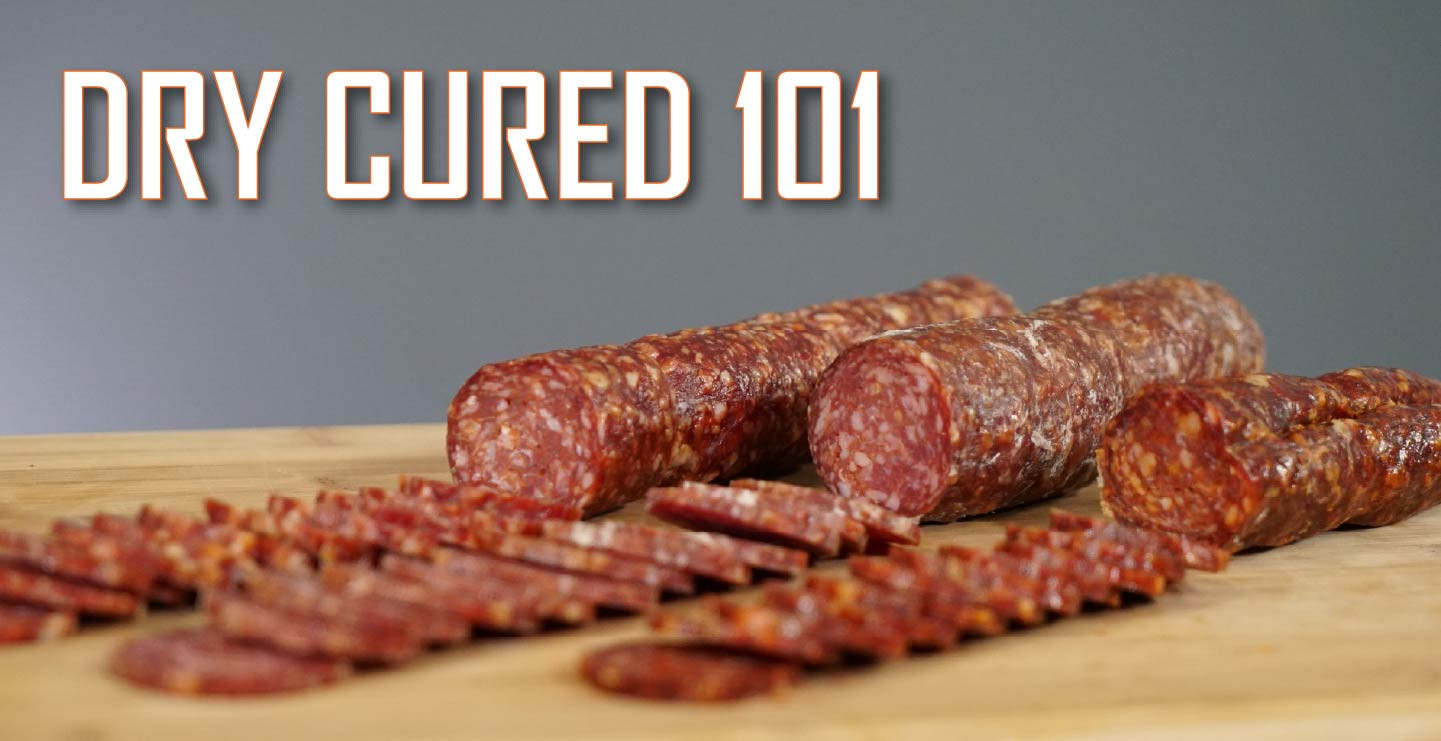
Dry Cured Sausage 101
Did you know many of our favorite deli meats like salami, prosciutto, and capocollo are never cooked? Instead, they’re dry-cured, an ancient preservation method that’s still trusted today. The safety comes not from heat, but from lowering the meat’s pH and carefully controlling temperature and humidity while it dries. The result? A product that’s safe, flavorful, and delicious.
Did you know many of our favorite deli meats like salami, prosciutto, and capocollo are never cooked? Instead, they’re dry-cured, an ancient preservation method that’s still trusted today. The safety comes not from heat, but from lowering the meat’s pH and carefully controlling temperature and humidity while it dries. The result? A product that’s safe, flavorful, and delicious.
This guide walks you through the process of making dry-cured sausage using Bactoferm T-SPX starter culture. T-SPX is a slow-acting culture that works well at lower temperatures, making it perfect for beginners and for long, traditional-style cures.
Make Dry-Cured Sausage with T-SPX Starter Culture
Did you know many of our favorite deli meats like salami, prosciutto, and capocollo are never cooked? Instead, they’re dry-cured, an ancient preservation method that’s still trusted today. The safety comes not from heat, but from lowering the meat’s pH and carefully controlling temperature and humidity while it dries. The result? A product that’s safe, flavorful, and delicious.
This guide walks you through the process of making dry-cured sausage using Bactoferm T-SPX starter culture. T-SPX is a slow-acting culture that works well at lower temperatures, making it perfect for beginners and for long, traditional-style cures.
- Starter culture: Bactoferm T-SPX (critical for the pH drop).
- Seasoning: A classic blend such as Salami Seasoning; add cracked black pepper or dry red wine for extra flavor.
- Meat: Pork butt is the best choice, thanks to its ideal fat content. Look for good fat caps and minimal purge.
- Casings: Inedible collagen casings are recommended. They require prep, but they dry sausage more consistently.
- Tip: Follow the “Rule of 15s” soak casings for 15 minutes in 59°F (15°C) water with a 15% salt solution.
- Debone pork butts and separate lean meat from fat.
- Grind fat once through a 3/8” plate for nice, large fat chunks.
- Grind lean meat twice: first through a 3/8” plate, then through a 3/16” plate.
- The 3/16” grind creates slightly larger particles, which helps moisture migrate during drying.Mix the correct amount of T-SPX in lukewarm water (70–100°F).
- Let it sit for at least 20 minutes to “wake up” before adding to the meat.
- Add seasoning, Sure Cure, and T-SPX culture to the ground meat.
- Mix with a meat mixer until just before protein extraction (the point where the meat turns sticky).
- Stuff the mixture into your prepared casings.
- Place sausages in a curing chamber at 72°F and 85% relative humidity.
- Leave for up to 3.5 days.
- After 3 days check the pH of your sausage, your goal is below 5.3.
Use the degree hours formula:
-
Multiply the degrees above 60°F by the number of hours in the chamber.
-
Example: 72°F (12° above 60) × 84 hours (3.5 days) = 1,008 degree hours.
-
Stay below 1,200 for safe fermentation at under 90°F.
-
-
Once pH has been verified ower the temperature to 54-66°F and the humidity down to 65%
- Drying continues until the sausage loses 25–50% of its weight, once that has been reached your sausage is ready to be enjoyed!
Quick Steps
-
Debone pork butts, separate fat and lean.
-
Grind fat (3/8”), grind lean (3/8” then 3/16”).
-
Activate T-SPX in lukewarm water, 20 minutes.
-
Add seasoning, cure, and culture; mix until tacky.
-
Stuff into casings.
-
Ferment 3–3.5 days at 72°F, 85% RH.
-
Check pH (<5.3) and calculate degree hours (<1,200).
-
Lower to 65°F, 70% RH.
-
Dry until 25–50% weight loss.
In-depth information
The first step in making dry-cured sausage is gathering the right supplies and equipment. For beginners, we recommend using Bactoferm T-SPX Meat Starter Culture, which is crucial for achieving the necessary pH drop to make the meat safe to consume. Next, choose a classic seasoning like our Salami Seasoning. You can enhance the flavor by adding extra black peppercorns or even a splash of dry red wine for added authenticity.
When selecting the meat, pork is widely regarded as the best choice for dry-cured sausage. Pork butts are ideal due to their perfect fat content. Be sure to pick pork butts with good fat caps and minimal purge in the vacuum package, or buy them fresh from a local butcher for the best results.
Next, we want to grind our pork, paying close attention to particle size, which is a key aspect of what makes the presentation of dry-cured sausage special. Start by trimming off the fat cap and any other large portions of fat and grinding them separately. The pork fat should be ground once through a 3/8" plate to create nice, large fat chunks in the finished product. Grind the lean pork twice: first through a 3/8" plate and then through a 3/16" plate. We use the 3/16" plate instead of the 1/8" plate because slightly larger particles in the meat make it easier for moisture to transfer from the inside of the sausage to the surface, where it can evaporate.
While doing this, we want to mix the correct amount of T-SPX for our meat batch in warm water and let it sit for at least 20 minutes; this will start to "wake" the culture up and activate it. Add your T-SPX, Seasoning, and Sure Cure to the meat, then mix it with a meat mixer until just before you achieve protein extraction, where the meat gets sticky. Next, stuff the mixture into your casing of choice. We recommend inedible collagen casings. Although they require more preparation, they have the ideal transfer rate to ensure the meat dries correctly. Remember the "rule of 15s" for inedible collagen casings: soak them for 15 minutes in 15°C (59°F) water with a 15% salt solution.
We want to hang our sausage in the dry curing chamber at 72°F and about as high humidity as possible. T-SPX is a slower-acting culture, but it also has the lowest optimal temperature for growth, so it allows us to do the entire process in the dry curing chamber, whereas other cultures might require you to put them in a smoker or other device that can achieve temperatures above 100°F.
Now we have to talk about "degree work hours. " Unfortunately, we will have to do a little math! Fortunately, the formula is pretty easy! The formula for degree hours is simply to multiply the degrees above 60°F by the number of hours it took to reach the target pH. For anything under 90°F, you cannot exceed 1200 work hours, 90-100 is 1000 hours, and above 100 is 900 max.
What we would recommend when using T-SPX is to check your sausage after 3.5 days to see if it is below 5.3; if it is, and if that is as acidic as you want your sausage, just take the 12 (difference between our set temperature of 72° and the base of 60°) and multiply that by how many hours it was in the cabinet, in this case, 3.5 days would be 84 hours. We get 12*84+1,008, below the maximum time of 1200 hours, so we are safe!
Now that we have achieved our target pH below 5.3, we want to change our humidity and temperature and dry the sausage to the consistency we want. First, you will want to lower the temperature to somewhere around 60° (54-66 range is acceptable), and then the humidity will need to be set around 65% for the sausage to dry correctly. Now, there needs to be some swings in the humidity, so it will sometimes be around 72 and sometimes as low as the high 50s. Without these swings the sausage won't dry correctly, as this helps draw the moisture from the interior of the sausage and then let it evaporate off the skin.
Once the product has lost 25-50% of its weight, it can be pulled from the cabinet, sliced, and enjoyed! It should be stored in vacuum packages, and we recommend keeping it in the fridge for extended shelf life, but it is perfectly fine to grab some and take it on a long backpacking trip without refrigeration!
Recent Posts
-
Collagen Casings 101: Choosing the Right Casings for Every Sausage
If you've ever made sausage or snack sticks with collagen casings and ended up frustrated with blowo …5th Jun 2026 -

How to Make Turkey Jerky from Wild Game
If you're looking for a new way to use wild turkey breast, jerky might just become your go‑to. Turke …29th May 2026 -

How to Make Skinless Snack Sticks (No Casings, No Smoker)
If you love snack sticks but don't love dealing with casings or firing up the smoker, skinless snack …22nd May 2026